
Founder's Article
Why I Chose Equitable Care for All as the Vision for Archle Labs
I often say the future of healthcare must be built on one principle: equitable care for all.
Not equal care, Equitable care.
For me, this is not a slogan. It is not a line written for a presentation or a website. It comes from what I saw at home growing up, what I witnessed during COVID, and what I still cannot stop seeing in the world around me.
I come from a family of social workers. Some of my earliest memories are of watching my parents constantly travel for social work, meeting beneficiaries from tribal, rural, and urban communities, listening to their struggles, and standing with them when life was difficult. I learned empathy from them not as a soft value, but as a duty. They taught me to think from the perspective of the vulnerable. They taught me to ask what life feels like for the person who has the least access, the least power, and the least room for error. They taught me that when people are suffering, you do not stand at a distance and observe. You go closer. You listen. You stand with them.
That stayed with me. But COVID changed the weight of that lesson forever.
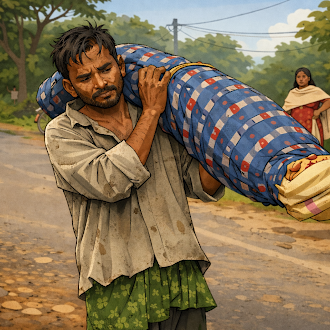
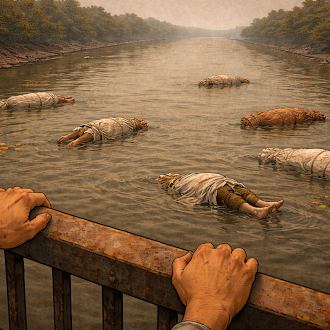
During the pandemic, I saw two things that I still cannot forget. I saw the images of migrant workers walking back to their home states because work had disappeared, transport had collapsed, and survival itself had become uncertain. And later, during the second wave, I saw the horror of reports about bodies being found in and along the Ganges, with officials and reporting linking those scenes to poverty, fear, and breakdowns in funeral arrangements. Those were not just shocking news events. They were warnings. They showed what happens when crisis hits a deeply unequal system. The pain is not distributed equally. The poor suffer first, and they suffer worst. (The Tribune)
For me, it was not only in the news.
I saw people die with my own eyes, one after the other. I saw nurses cry because they wanted to do more but could not. I saw helplessness in its most painful form. I saw how quickly human effort reaches its limit when the system around it is too weak, too delayed, too uneven, or simply too absent. Those moments stayed with me. They stripped away any illusion I had about healthcare being mostly a matter of hospitals and doctors. I understood something much harder: in healthcare, the line is not only between illness and treatment. The line is between those who can get care in time and with dignity, and those who cannot.
What this vision means
Build for the person with the highest barriers, not the easiest user. That is the standard behind equitable care.
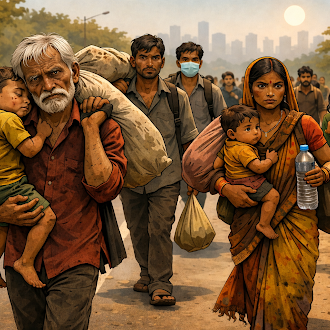
What I also realized is that this is not only an Indian problem. It is a human problem.
The more I read and see, the harder it becomes for me to accept how unequal healthcare still is. We call health a basic human right, but the reality is far from that. In 2023 alone, about 260,000 women died during and after pregnancy and childbirth. Around 92% of those deaths happened in low- and lower-middle-income countries, and sub-Saharan Africa accounted for about 70% of global maternal deaths. I cannot look at those numbers as just data. To me, they are proof that something as basic as surviving pregnancy still depends too much on where a woman is born, what system she is born into, and whether care reaches her in time.
And this inequality is not limited to poorer parts of the world. Even in places we call advanced or developed, timely care is still not guaranteed. Across 28 OECD countries, 3.4% of people reported unmet medical-care needs in 2024 because of cost, distance, or waiting times, and people in lower-income groups were 2.5 times more likely than higher-income groups to face those unmet needs. In England, the NHS waiting list for planned care was still 7.36 million in May 2025. That tells me this struggle changes its form from one country to another, but it does not disappear. In one place, the problem is the absence of care. In another, it is delay, affordability, or access. But in both cases, people are still being asked to suffer longer than they should.
India reflects that same injustice in its own way.
On paper, numbers can create the illusion that healthcare exists. But paper is not the same as reality. In rural India, the shortage of specialist care is still severe. Official health reporting said community health centres had only 4,413 specialists against a requirement of 21,964 in March 2023, a shortfall of 79.9%. That means millions of people are expected to depend on a system that is not truly ready for them when serious care is needed. (Ministry of Health and Family Welfare)
And cities are not automatically better. That is another hard truth. We often talk as if urban India has access and rural India has scarcity. But even inside cities, inequality is everywhere. UNICEF has noted that the gap between the urban poor and the non-poor is so deep that, on many indicators, urban poor children are worse off than children in rural areas. Census-based government data recorded about 65.49 million people living in slums in 13.9 million households in 2011. That is not a small number. That is a warning about how many people are living one illness away from disaster, even in cities. (UNICEF)
That is why I say this is not only about healthcare availability. It is about healthcare reach. It is about whether care gets to the person who needs it most, when they need it, in a form they can actually access. Being in a city does not guarantee timely care. Proximity is not the same as access. Delay, overcrowding, lost wages, poor living conditions, weak public systems, and lack of visibility into available services all become health barriers.
Even today, I still see reminders of how cruel and unequal this can be. Last month in Faridabad, a poor family had to take a woman’s body home on an open motorised pushcart because they could not afford transportation and no ambulance or hearse was provided. The Haryana Human Rights Commission called it “a direct assault on human dignity, constitutional values and the very concept of a welfare state.” In another recent Haryana case, the National Human Rights Commission sought a report over alleged segregation at a cremation ground in Hisar linked to social identity. These incidents show that inequality does not end with treatment. Sometimes it extends into death and final rites as well. (The Tribune)
Core idea
Healthcare access is not defined only by whether facilities exist. It is defined by whether real people can reach them in time, afford them, navigate them, and receive dignified care.
Why equity
Equal care sounds fair. Equitable care is what real life demands.
That is why I cannot sit quietly in the face of so much cruelty and injustice.
I genuinely cannot make peace with a world where some lives move quickly through the system while others are left to wait, travel, borrow, beg, or give up. I cannot make peace with a world where someone’s survival still depends more on money, influence, social identity, geography, or timing than on medical need. Healthcare is one of the most basic expressions of human dignity. If we cannot deliver that fairly, especially after seeing so much suffering, then something fundamental in our humanity has failed. (who.int)
This is also why I do not believe equal care is enough.
Equal care sounds fair, but life is not equal. A patient in a crowded urban settlement, a family in a village, a tribal community far from formal infrastructure, an elderly person with low mobility, and an overburdened nurse in a small hospital are not starting from the same place. Their barriers are different. Their risks are different. Their timelines are different. If the barriers are different, the response cannot be identical. That is why equity matters more than sameness.
To me, equitable care means building systems around reality, not around theory. It means accepting that distance matters, poverty matters, overcrowding matters, awareness matters, language matters, coordination matters, and delay matters. It means understanding that the people who are most vulnerable do not need a healthcare system that looks good from far away. They need one that actually reaches them.
I also believe digital care has a serious role to play here.
Not because technology can replace doctors, nurses, beds, oxygen, or compassion. It cannot. But in a country where healthcare resources are limited and unevenly distributed, digital systems can reduce some of the damage caused by scarcity. They can support earlier triage, help frontline workers, improve continuity of care, widen access to specialists, and create more visibility into where services and resources are available. India’s national telemedicine service, eSanjeevani, describes itself as a step toward digital health equity and had served over 311 million patients as of 10 November 2024. That tells me digital care is not just about convenience. At its best, it can help make access less dependent on geography and delay. (Ministry of Health and Family Welfare)
At the same time, I do not want to pretend that everything is hopeless.
Progress is possible. India’s official National Health Accounts show out-of-pocket spending as a share of total health expenditure fell to 39.4% in 2021-22. Government data also said 1,75,418 Ayushman Arogya Mandirs had been operationalized by 10 December 2024. None of this means the problem is solved. But it does mean change is possible when we decide that access, affordability, and equity are not side issues. They are the issue. (Ministry of Health and Family Welfare)
That is why Archle Labs exists.
I did not choose this vision because healthcare is a large market. I chose it because I do not want to build for the few while the many remain unseen. I chose it because I have seen what happens when care does not arrive in time, when systems are not designed for real life, and when dignity becomes a privilege instead of a right. I chose it because innovation means very little if it only serves those who are already visible, already connected, already informed, and already safe.
When I say equitable care for all, I mean care that recognizes context. Care that reaches the last mile. Care that reduces delay. Care that gives frontline workers better tools. Care that does not silently ask whether a person is rich enough, connected enough, visible enough, or socially advantaged enough to be saved.
I want Archle Labs to build for that future.
For the underserved. For the vulnerable. For the communities that are easiest to ignore until you truly see them. For the people whose lives should never have been treated as if they mattered less.
Because the future of healthcare should not be defined by privilege.
It should be built on one principle: equitable care for all.